
I Already Have an AVR, So Why Would I Need a Separate Power Amplifier?

I Already Have an AVR, So Why Would I Need a Separate Power Amplifier?
Actually, that is a very good question, and we’re going to take a stab at it here.
However, to best answer the question a bit of history is in order. Let’s go back to the dawn of what was then called “hi-fi” in the early 1950’s. Along with source devices such as a turntable, at the front end, and the speakers at the back end, in the middle were the electronic components:
•A preamplifier does what its name says: It selects between sources, increases their output signals so that an amplifier can, again the name says, amplify the low-level signals so that the power amplifier down the chain can do its work.
•One of those sources to be selected from, particularly in the early days, was an AM/FM, and later top include FM Stereo, tuner.
•Finally, the power amplifier that, as previously noted, increases the signal's amplitude so that it can drive speakers.
Having all those separate components gave the hi-fi hobbyist at the time a great deal of choice, but to be honest it was complicated for many people; it definitely increased the cost of the system and was a bit difficult to operate. Then came the light-bulb moment when someone got the idea of combining all three functions into one single product. The person generally credited with coming up with that idea was Dr. Sidney Harman, and the result was the Harman-Kardon Festival D-1000, the first “integrated consumer audio receiver”. All three of those functionality blocks: A tuner, a preamp and an amplifier in one product! What a concept!
Since then, the concept of the “receiver” as an audio and later audio/video product has evolved from monaural receivers to two-channel stereo receivers, to multi-channel audio/video receivers to today’s digital AVRs. As an aside, we’d be remiss in not mentioning our own RR2160MkII two-channel receiver. It also shows the evolutionary path of the receiver as the RR2160MkII incorporates the three key components that define a “receiver”, but along with a tuner it adds streaming capability.
With everything in one place one might think that you’ve got it all and don’t need to add anything other than source devices, speakers and a TV or projector for a display. In most instances that is correct, but for some it isn’t. That’s where the Outlaws come into the picture with a variety of power amplifiers that can, literally, add to the power of your AVR.
The reason is that AVRs (and two-channel receivers) have to incur the cost of all the components needed to deliver the sound. In parallel, they must budget the costs so that the end product meets the desired retail price. When you factor in the cost of the audio and video processing, HDMI and wireless connectivity, licensing costs, and today let us not forget the tariffs on imported products, sometimes something has to give and often that “something” is the amplifier power output.
We’re not at all saying that the amplifier section of your AVR is bad; within reason it is probably just fine. However, have you added more speakers to what was originally a 5.1 or 7.1 system? Have you upgraded your speakers to ones that sound better, but which are less efficient than your old speakers? Have you moved to a larger room where you are always being asked to “TURN IT UP”? Do you just feel that with the great dynamic range of today’s movies, concert videos and streaming service series you are just not as happy with the sound as you once were?
If that is the case, there is probably nothing wrong with your AVR. Instead, you just probably need to send more power to more channels at the same time than you did when you first purchased your AVR. Sure, you can buy a new AVR with a more powerful amp section, but that can be costly. Instead, consider this suggestion from the Outlaws: Add an Outlaw Audio power amplifier to all or some of the output channels from your AVR.
When every watt counts, particularly when the output power of your AVR is under 100 watts, ALL CHANNELS DRIVEN, Outlaw amplifiers save the day. When every watt counts, an external power amplifier can be the easiest solution to an underpowered home theater system.
Three Outlaw amplifiers give you the power you need with the flexibility to upgrade as best suits your needs and budget.
The three main Left/Center/Right (LCR) front soundstage speakers are the most important as they carry the dialog and main action. For that we recommend the Model 2220, a small, but powerful amp that delivers 200 watts at 8 ohms and 300 watts at 4 ohms. Use one for just the center channel or three for the full front stage.
For a fuller system upgrade the Model 5000x powers five channels with 120 watts into 8 ohms and 180 watts into 4 ohms. This is great for a standard 5.1 system or use Model 2220’s for the L/C/R and a Model 5000x for the surround channels in a 7.1 system.
For larger scale systems, the Model 7000x powers seven channels with 130 watts into 8 ohms or 200 watts into 4 ohms. This can give you equal power to all channels in a 7.1 system or pair it with a Model 5000x for even larger immersive 11.1 systems using Dolby Atmos® or DTS:X®
Depending upon your setup, the improvement can be incredible; plus, you have the added benefit of having an amplifier that you can use going forward if you upgrade your system from an AVR to a surround processor. After all, you already have the amp!
Is there a catch?
Well, there are two important things to know: in order to power an amplifier, your AVR needs to have preamp outputs. A rough rule of thumb is that if your AVR costs over $1,100 it is likely to have the outputs you need, but you should always check before ordering. Your owner’s manual or the web page for your AVR will tell you if you have these needed connections. Or, take a look at the back panel of your AVR to see if there are RCA (or XLR) jacks labeled “PRE-OUT” that look like these.
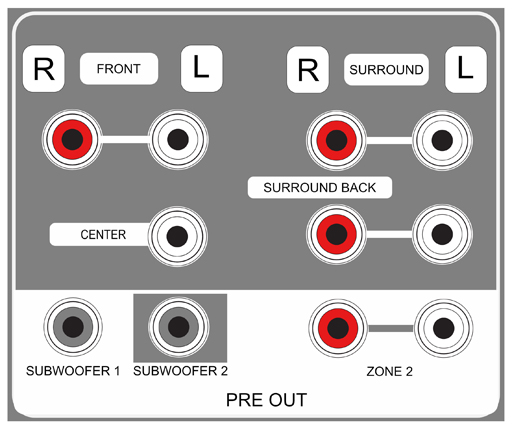
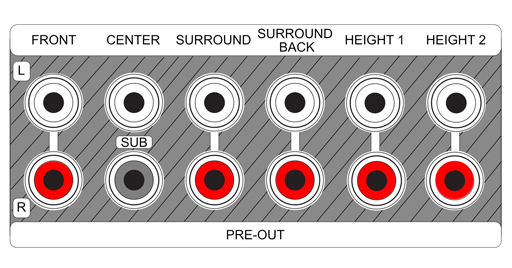
What else do you need to know?
The other important factor, once you have confirmed that your AVR has preamp outputs, is “Input Sensitivity”. Having the right range of input sensitivity is important; if the amp’s input sensitivity is too low (very sensitive), the amp may reach full power with only a small volume increase on the AVR, reducing usable volume range and increasing the risk of noise or hiss. If the sensitivity is too high (less sensitive), the AVR may not be able to deliver enough voltage to fully drive the amp, limiting maximum output and dynamic headroom.
Proper matching ensures:
•Full amplifier power is available when needed
•Smooth, predictable volume control
•Optimal signal-to-noise ratio
To match your AVR with an Outlaw amplifier, or for that matter most any amp, look for an Input Sensitivity in the range of 1.2VRMS to 1.7VRMS. We’ve put together a chart with some of the more popular AVRs that Outlaw customers have asked us about. If your AVR isn’t listed look for the spec on your AVR manufacturer’s web site or in the spec listing typically found in the back of an Owner’s Manual. It’s much easier to figure this out than it sounds, but if you still have a question about whether your AVR is a good match send us an email at [email protected] and we’ll be happy to help you.
Now that you know the “why” and “how” about adding an AVR, you’re almost ready to rock with just a few things more to consider.
First, how many channels do you need? If you are just looking to pump up the front soundstage, three Model 2220 Monoblocks are a great way to bring full power to the Left/Center/Right (LCR) channels. If you need more power for surround and height channels a five-channel Model 5000x or seven channel Model 7000x can power all the surrounds you have. Alternatively, mix and match to have the right power to the right channels. Remember that the front LCR channels are where the bulk of the sonic action is pointed, particularly to the center channel.
Secondly, speaking of power, take a step back and look at not only the number and type of speakers you have, where they are placed, what channel function they are tasked with and, most important, what is the room size and other acoustic conditions. To help distill that into a suggestion for what power is needed, try our Power Calculator by clicking here
With all of this in hand, you will clearly say that adding an external amp to an existing AVR might not be as silly a thing as it might seem. Indeed, dollar-for-dollar, if the specs match, this might be the best investment you can make to upgrade your home entertainment system! Check out our amplifiers at https://outlawaudio.com/shop/11-power_amplifiers. We look forward to having you join the Outlaw family.
Have two pairs of speakers \n\nBookshelves and towers \n\nCan I run both on a single amp?